






Deciding whether to repair or replace your AC unit can be a difficult choice for many homeowners. A major repair or a full AC replacement is a significant investment, and knowing which option makes the most sense can impact your comfort, long-term costs, and your home's efficiency.
Factors like your air conditioner's age, repair costs, energy usage, maintenance history, and overall performance can help determine whether it makes more sense to fix your current system or consider a replacement. For many homeowners facing AC replacement, it's also worth exploring whether a heat pump could provide a more versatile heating and cooling solution for their home.
We'll walk through when AC repairs make sense, the key signs it's time to replace your air conditioner, and why more homeowners are considering heat pumps and geothermal systems as alternatives to traditional air conditioning.
5 Questions to Ask Before Replacing Your AC Unit
1. How long does an AC unit last?
Standard central air conditioning systems typically last around 10 to 15 years, although the actual lifespan of an AC unit can vary depending on installation quality, maintenance, climate, usage, and other factors.
With regular professional maintenance, some systems can continue operating effectively beyond 15 years. However, older AC units generally require more repairs and may become less efficient as components wear down.
Climate can also play a role in how long an air conditioner lasts. Hotter summers and long cooling seasons can cause an outdoor condenser to run for extended periods, putting additional wear on components such as the compressor, fan motor, and electrical components.
If your AC unit is approaching or exceeding 15 years old, it's worth looking at the bigger picture before putting significant money into another repair. A repair may get you through another cooling season, but replacing an aging system could provide better efficiency, reliability, and comfort over the long term.
2. How much will repairs cost compared to replacement?
The cost of the repair is one of the biggest factors homeowners should consider when deciding whether to repair or replace an AC unit.
You may have heard of the "Rule of $5,000," which is sometimes used as a quick way to evaluate a repair. The basic idea is to multiply the estimated repair cost by the age of the air conditioner. If the result is greater than $5,000, replacement may be worth considering.
For example, a $500 repair on a 5-year-old AC unit would equal $2,500, while that same $500 repair on a 15-year-old system would equal $7,500.
The $5,000 rule isn't a hard-and-fast industry standard, but it can be a useful starting point. Homeowners should also consider the type of repair, the system's overall condition, expected remaining lifespan, and how efficiently the unit is operating.
A minor repair on a relatively new system is usually easier to justify. A major repair on an older system—especially if you've already paid for several repairs in recent years—may be a sign that replacement is the better long-term investment.
3. Is your AC unit still keeping your home comfortable?
An air conditioner should be able to maintain a relatively consistent indoor temperature without constantly struggling to keep up.
If your home has developed hot and cold spots, the system runs continuously on hot days, or you're frequently adjusting the thermostat without getting comfortable, there may be an issue with the equipment, airflow, sizing, ductwork, or overall system performance.
Another issue to watch for is short cycling, which occurs when an air conditioner repeatedly turns on and off before completing a normal cooling cycle. Short cycling can increase wear on the system and may lead to higher energy consumption and reduced comfort.
Other warning signs include:
- Weak airflow from vents
- Unusual or increasingly loud noises
- Unpleasant odors coming from the system
- Excessive humidity indoors
- Frequent thermostat adjustments
- The system is struggling to keep up on hot days
- Increasingly frequent service calls
Some of these problems can be corrected with a repair or maintenance visit, so they don't automatically mean you need a new AC unit. However, when multiple issues occur on an older system, replacement may make more sense than continuing to invest in repairs.
4. How efficient is your current HVAC system?
Energy efficiency is another important consideration when deciding whether to repair or replace an air conditioner.
Older AC systems were often designed around efficiency standards that are lower than those available with many modern systems. Today's high-efficiency air conditioners and heat pumps can offer improved performance while using less electricity to provide the same amount of heating or cooling.
If your energy bills are climbing even though your usage hasn't changed significantly, your aging air conditioner may be part of the problem.
Regular maintenance can help keep an AC unit operating efficiently. Homeowners should replace air filters regularly, keep the outdoor condenser clear of debris, and have the system professionally inspected and serviced as recommended by the manufacturer.
Preventative maintenance can help identify issues before they become major repairs, but it can't stop normal wear and tear forever. Eventually, even a well-maintained AC system will reach the point where replacement makes more financial sense.
When replacing an older system, it's worth comparing not just the purchase price of the equipment, but also its expected operating costs over the next 10 to 15 years.
Common Signs Your AC Unit Needs to Be Replaced
There isn't one single rule that determines when an air conditioner needs to be replaced. However, several warning signs can indicate that your system is approaching the end of its useful life.
Frequent AC Repairs
If you're calling an HVAC contractor every summer, repair costs can quickly add up. One repair doesn't necessarily mean it's time for a new system, but repeated repairs are worth considering when you're evaluating the total cost of keeping an aging AC unit running.
Major repairs involving components such as the compressor or coils can be particularly difficult to justify on an older system.
Rising Energy Bills
An aging air conditioner can lose efficiency over time. If your cooling costs continue to rise despite normal usage and regular maintenance, replacing an older system with a higher-efficiency model could reduce energy consumption.
Keep in mind that utility rates, weather, insulation, ductwork, and thermostat settings can also affect energy bills, so higher costs don't automatically mean the AC unit is the problem.
Uneven Cooling
Rooms that are consistently warmer or cooler than the rest of the house can be frustrating. Uneven temperatures may be caused by ductwork, insulation, airflow, system sizing, or an aging air conditioner.
If the equipment itself is reaching the end of its life, replacement gives your HVAC contractor an opportunity to evaluate the entire system and make sure the new equipment is properly matched to the home.
An Aging Refrigerant System
The refrigerant used by your AC system is another factor to consider. Older air conditioners may use refrigerants that are being phased out or are becoming more difficult and expensive to obtain.
If an older system develops a refrigerant leak, the cost of repairing the leak and servicing the system may make replacement a more attractive option.
5. Should you replace your AC with a heat pump?
If you're already considering replacing your air conditioner, it's worth asking whether you should replace it with another traditional AC system or consider a heat pump instead.
An air source heat pump provides both heating and cooling from the same system. During the summer, it operates much like a traditional air conditioner by moving heat out of your home. During the heating season, it reverses the process to bring heat into the home.
That means a homeowner replacing an aging AC unit may have an opportunity to upgrade to a system that provides year-round heating and cooling rather than simply replacing the cooling portion of their HVAC system.
Modern air source heat pumps can provide several advantages, including:
- Heating and cooling from one system
- High efficiency during both heating and cooling
- Consistent indoor comfort
- Quiet operation
- Potential eligibility for local utility rebates or incentives
- Reduced reliance on a separate heating system
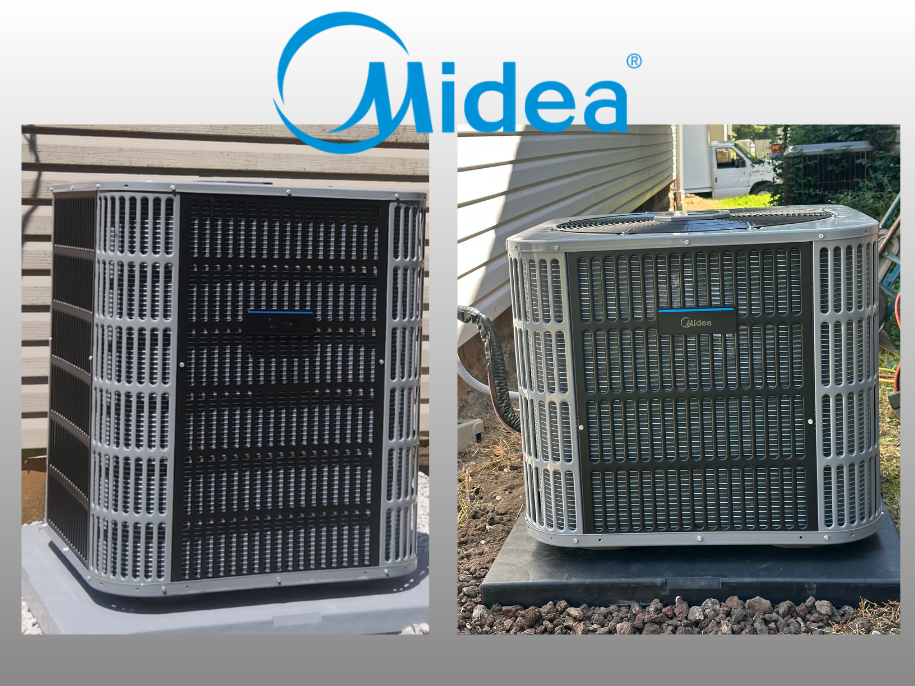
For homeowners looking for an alternative to a traditional AC replacement, Midea air source heat pumps are one option to consider. Midea offers heat pump systems designed for residential applications, including side-discharge equipment that can be a good fit for installations where space is limited.
Explore Midea Air Source Heat Pumps
If you're an HVAC contractor looking for replacement equipment, you can also explore our selection of Midea AC condensers to find traditional cooling equipment for replacement applications.
What About Geothermal Heat Pumps?
For homeowners who are planning to stay in their home for many years, replacing an AC system can also be an opportunity to consider geothermal heating and cooling.
A geothermal heat pump uses the relatively stable temperature of the ground as a heat source in the winter and a heat sink in the summer. Instead of rejecting heat into the outdoor air like a conventional air conditioner, a geothermal system exchanges heat with the ground through an underground loop system.
Geothermal systems can offer extremely efficient heating and cooling, quiet operation, and long equipment life. They also eliminate the need for a conventional outdoor condenser.
Geothermal isn't the right solution for every home or budget, since installation requires an underground loop field and typically has a higher upfront cost than replacing an existing AC condenser. However, for homeowners planning a long-term investment in their property, the lower operating costs and long equipment life can make geothermal worth considering.
Explore Our Geothermal Heat Pumps
How Much More Efficient Is a New AC Unit?
If your current air conditioner is 10 to 15 years old, replacing it with a modern high-efficiency system may provide a noticeable improvement in energy performance.
Today's equipment is available with significantly higher efficiency ratings than many older systems. When comparing equipment, homeowners may see SEER2 ratings used for cooling efficiency, while heat pumps also have heating efficiency ratings such as HSPF2.
Higher efficiency doesn't necessarily mean that the most efficient system is automatically the best choice for every home. Equipment cost, climate, system sizing, ductwork, usage, electricity rates, and installation all affect the actual return on investment.
That's why it's important to look at the complete system rather than choosing equipment based solely on its efficiency rating.
A properly sized and installed system can also provide benefits beyond energy savings, including:
- More consistent temperatures
- Better humidity control
- Quieter operation
- Improved airflow
- More modern controls and thermostat compatibility
- Improved reliability
When Does Repair Make Sense?
Repairing your AC unit may be the better choice when:
- Your system is relatively new and still has significant useful life remaining.
- The problem is minor and doesn't indicate a larger equipment issue.
- The repair cost is reasonable compared with the cost of replacement.
- Your energy bills and comfort are still acceptable.
- The system has been reliable and hasn't required frequent repairs.
For example, replacing a worn capacitor, contactor, fan motor, or other relatively minor component may be a much better investment than replacing an otherwise healthy air conditioner.
When Does AC Replacement Make Sense?
Replacing your AC unit may make more sense when:
- The system is older, particularly when it is approaching or exceeding 15 years.
- Repairs are becoming frequent.
- A major component has failed.
- Your energy bills are increasing.
- Your home isn't staying comfortable.
- The system uses an older refrigerant.
- You're planning to stay in the home long enough to benefit from improved efficiency.
Replacement can also be an opportunity to rethink the type of HVAC system you're using. Instead of simply replacing an aging AC condenser, homeowners can compare a traditional air conditioner with an air source heat pump or, for certain properties, a geothermal heat pump.
Repair or Replace Your AC: What's the Right Choice?
Ultimately, there isn't a single answer for every homeowner.
If your air conditioner is relatively new, has been properly maintained, and needs a minor repair, repairing the system may be the most economical choice.
If your AC unit is older, requires frequent repairs, has declining efficiency, or is no longer keeping your home comfortable, replacement may provide better long-term value.
And if you're already replacing the system, don't limit the conversation to a one-for-one AC replacement. A high-efficiency air conditioner, air source heat pump, or geothermal heat pump could provide a better solution depending on your home's needs, climate, budget, and long-term plans.
At Supplied Energy, we help contractors find the equipment they need for residential heating and cooling projects, from Midea AC condensers and air source heat pumps to geothermal heat pump systems.
Whether you're replacing an aging AC unit or designing a completely new heating and cooling system, choosing the right equipment is about more than the upfront price. Efficiency, reliability, installation requirements, operating costs, and long-term comfort all play a role in finding the right system.
Get a Free Quote